Tourism |
LANGUAGE AND LITERATURE
Nepal is a multilingual country as it has at least 120 different languages. Nepalese, the mother tongue of the country, is a language derived from Indo-European Pahari, Eastern Pahari and the Indo-Iranian family. It is the de facto lingua franca of Nepal. It is spoken by approximately 25 million people both inside and outside the country. In addition, Nepalese is also used in Bhutan, parts of India, and Myanmar. In its beginnings the language was called Khaskura and later it became Gurkhali (from the Gurkha ethnic group). It was also called Parbatiya, which means "mountain language" and Lhotshammika, which means "language of the south". Among the many languages and dialects that Nepal has, some have become extinct, such is the case of Dura, Kusunda and Waling. In addition to Nepalese, which is the official language of Nepal, other languages such as Newari, Awadhi, Limbu, Hindi, Mundari, Bahing and Maithili are also spoken. Nepali is believed to be the easternmost set of Pahari languages. This language is widely used in the vicinity of the Himalayas and is very similar to Hindi, the official language of India. Nepali is a living language that is strengthened through a large amount of literature and writing. Printed in Devanagari script which is only understood by those who speak Hindi and Urdu. The language brings together mysterious folk tales, which are a translation of the South Asian epic. There is also a version of the Holy Bible in the Nepalese language. Nowadays, English has become a very important language in Nepal. It is widely used in education, business, medicine and in different daily activities, even in Nepal english language television programs are broadcast. As Nepali literature we refer to the literature written in the language of Nepal, and should not be confused with Nepali literature. A work that is classified as Nepalese literature does not necessarily have to be written by a Nepali in Nepal. Much of today's Nepalese literature is largely written outside of Nepal and many of its prominent writers were born in other countries such as the writers Parijat and Indra Bahadur Rai. The language of Nepal evolved from Sanskrit and it is difficult to put an exact date on the country's literary history as most of the early scholars wrote in Sanskrit. However, it is possible that within its history we can classify it into several periods.
%20ESCRITURA%20NEPALESA.jpg/picture-200?_=17f2b53c2c0)
%20PARIJAT%20-%20ESCRIPTORA%20copia.jpg/picture-200?_=17f2b53bed8)
%20INDRA%20BAHADUR%20RAI%20ESCRIPTOR%20copia.jpg/picture-200?_=17f2b53baf0)

Pre-Bhanubhakta Period
Nepalese literature is believed to have existed in verbal folklore for hundreds of years, however there is no evidence of literary work written before Bhanubhakta (1814-1868). Bhanubhakta was a Nepalese poet who translated the Ramayana from Sanskrit into Nepali. Some scholars claim that the poet Suwananda was the first literary figure in the history of modern Nepal. Nepali writer Manjushree Thapa was born in 1968 and grew up in Nepal, Canada and the United States of America (USA). Her best known book is "Forget Kathmandu: An Elegy for Democracy (2005)", published just two weeks after the February 1, 2005 coup.
Bhanubhakta period
Many Nepalis honor Bhanubhakta as the "first poet" in the Nepali language. Without a doubt, his most important contribution to the literature of Nepal was his translation of the holy book of the Ramayana, which he wrote with a meter using the same form used in Sanskrit. In addition to the translation of the Ramayana, Bhanubhakta also wrote original poems with a wide range of themes, from family themes upholding morality, satires on bureaucracy, to themes on the poor conditions of prisoners. Motiram Bhatta (1923-1953) is the person who revived Bhanubhakta's legacy and made Bhanubhakta's contribution known.
Period 1960-1991
The Pre-Revolution era was very prolific for creative writing, despite the lack of freedom of expression. During this period, “Sharada” magazine was the only medium available for the publication of Nepali literature.
The short stories of Laxmi Prasad Devkota, Guru Prasad Mainali and Bishweshwar Prasad Koirala have been highly recognized and of great importance. It can be said that this period was one of the most important in the development of Nepali literature. Short stories, such as Laxmi Prasad Devkota's influential “Muna Madan”, tell narratives of human life. The story is about a man who to earn money leaves his wife, goes abroad and when he comes back he dies tragically. However, the story also shows the life of the woman, which she suffered extremely without the company of her husband.
Other Bishweshwar Prasad Koirala stories present psychology within literature, such as “Teen Ghunti”, “Doshi Chasma”, “Narendra Dai”, etc.
POST-REVOLUTIONARY PERIOD
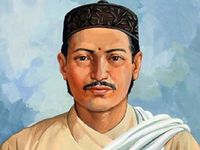
There are many modern Nepali authors who have been very innovative in the new literature of the country, such as Indra Bahadur Rai, Parijat, Narayan Wagle, Manjushree Thapa, Mahananda Poudyal, etc. Due to the emigration of people from Nepal, its literature has spread all over the world from the year 1990, and many books have been published in different corners of the planet. This literature has developed new forms of thought and transformation. Some writers and some novels offer an illuminating vision of the new identity models. Dharma Ratna Yami (1915-1975) was a great freedom fighter from Nepal. He changed his surname to Yami, which means inhabitant of Kathmandu in Nepal Bhasa, to avoid confusion with another Dharma Ratna when asked by a Buddhist monk who was who.
LITERATURE IN NEPAL BHASA
This literature refers to literature written in the Nepalese Bhasa language. This language has one of the four oldest literatures among the Sino-Tibetan languages (the first three Chinese and then the Tibeto-Burman). The first known document in Nepal Bhasa is called "The Palm Leaf of Uku Bahal", which dates from the year 1114 AD. during the Thakuri period.
FIRST BOOKS (14th century): Haremakhala, medical manual written in the year 1374. Naradsmriti, law book written in 1380. Amarkosh, Sanskrit-Nepal Bhasa dictionary written in 1381. Gopalraj Vamshavali, a history of Nepal written in 1389.
%20MAHANANDA%20POUDYAL%20-%20ESCRIPTOR%20copia.jpg/picture-200?_=17f2b53baf0)
NARAYAN%20WAGLE%20-%20ESCRIPTOR%20copia.jpg/picture-200?_=17f2b53b708)
THE CLASSICAL PERIOD
This was the golden age in the development of art and architecture in Nepal Mandala (an ancient region located in and around the Kathmandu Valley), as well as being a very prolific period in literature. The predominant literary genres at this time consist of chronicles, epics, stories, scientific manuals (related to astrology and medicine), poems, and drama.
The kings and queens of the Malla dynasty were enthusiastic lyricists and playwrights. Theatrical dances dating back to that time are still performed during festivals. King Mahindra Malla (reigned 1560-1574) is regarded as the first Nepalese Bhasa poet. Other notable poets among the Malla kings include Siddhi Narsingh Malla (1619-1669), Pratap Malla, Ranjit Malla, and Jaya Prakash Malla. Siddhi Narsingh Malla was the first Nepalese Bhasa playwright. He wrote a one-act play entitled "Ekadashibrata" in the year 1633 based on a Hindu story. His most famous work is “Katti Pyakhan (1641) which is shown every year in Patan Durbar Square. Queens Riddhi Laxmi (1680-1687), considered to be Nepal's first female poet, Jaya Laxmi and Bhuvan Laxmi were also noted composers.


THE DARK PERIOD
After the conquest by the ruling Shah dynasty of the Gorkha Kingdom of Nepal in the year 1768, and their rise to power, the Nepali language, formerly known as Khaskura or Gorkhali, began to overtake and unseat the Nepalese Bhasa language.
The suppression was initiated by the Rana dynasty (1846-1951). In the year 1906, official documents written in Nepal Bhasa were considered illegal. The use of the language for commercial or literary purposes was also prohibited. The books were confiscated and the writers were jailed. As a result, not only literary creations but general writings drastically ceased. The distance between the spoken language and the written language began to be greater and greater. A small number of hymns and religious stories were created at this time. As the most important writers of that period we can name Swami Abhayananda (brother of Prime Minister Bhimsen Thapa), Hari Bhakta Mathema, Man Bahadur Joshi and Bir Bahadur Malla.
THE RENAISSANCE PERIOD
During this period a new generation of writers emerged, who offered a literary production that defied the restrictions of the government. This renaissance era aimed to restore the lost glory of the Nepal Bhasa and stimulate literary creativity. The activities of this period laid the foundation for the future of the language.